
You have bought or rented a container – but how does it get to you, and what do you need to prepare? This page explains the delivery methods, how much space you need, which ground is suitable and what happens on the day of delivery.
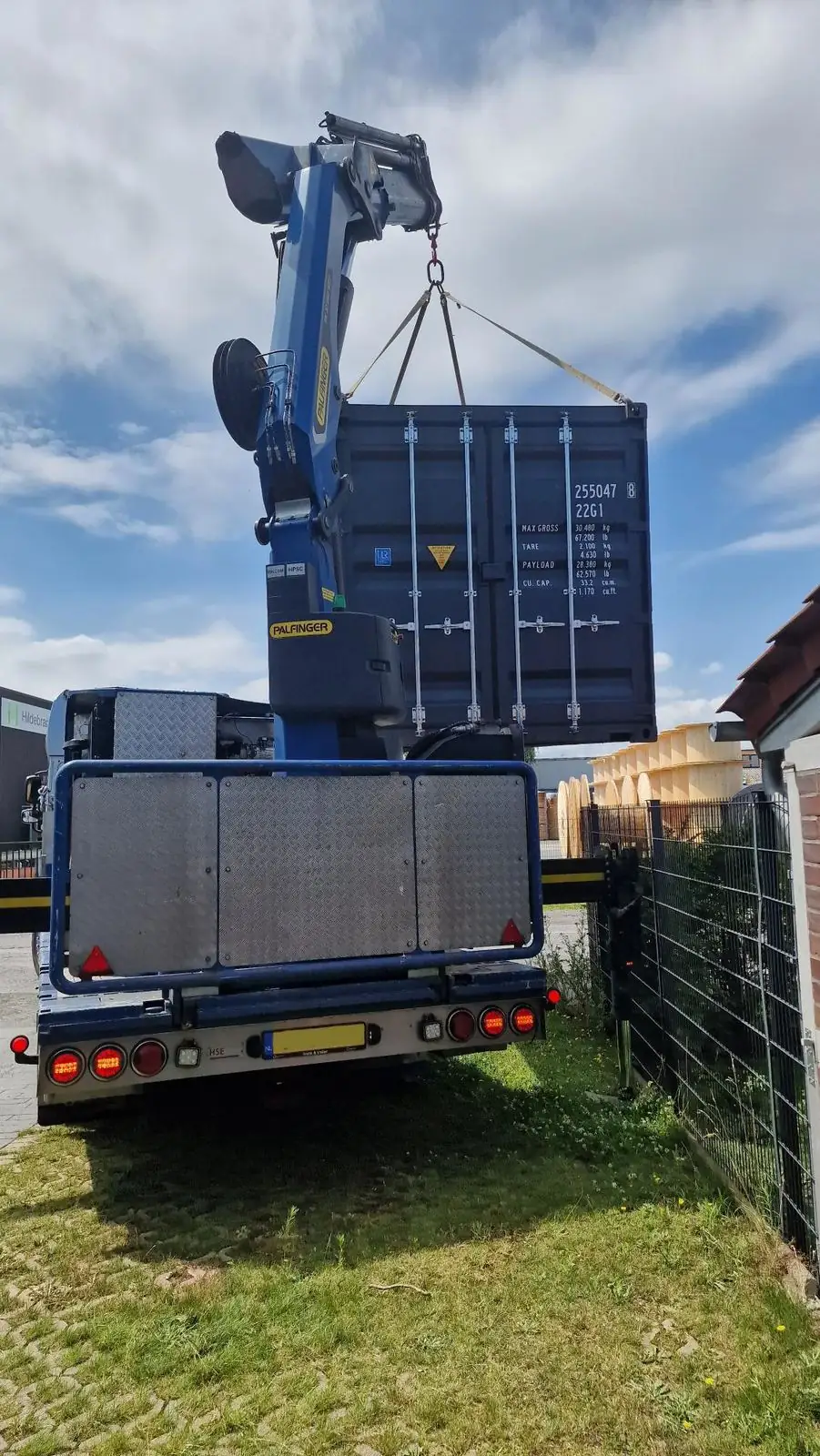
Delivery methods compared
| Delivery method | Use | What the container needs | Advantage |
|---|---|---|---|
| Truck with loader crane | precise offloading, tight sites | lateral swing area, load-bearing ground | Container is placed exactly where you want it |
| Tilt chassis | open area with run-out space at the rear | several metres of free space behind the offloading point | cheaper, fast |
| Low loader | 40 ft, multiple containers, long distances | transfer point with forklift or crane on site | Transport of large quantities |
| Self-collection | You have a suitable vehicle | — | no transport costs |
How much space do I need?
Always add manoeuvring space to the container length:
- Crane truck: Container length + approx. 3 m lateral swing area for the crane arm + access for a 12–18 m long truck.
- Tilt chassis: Container length + several metres of roll-off distance directly behind it, because the container slides off towards the rear.
- Height: Check overhead lines, branches, gate and passage heights – a High Cube is almost 3 m high, and considerably more while it is being lifted by a crane truck.
The right ground surface
The ground must be load-bearing and level : compacted gravel, concrete slabs or asphalt. Under the container's four corner castings, the entire load acts as a point load – on soft lawn or soil, the container sinks in and warps. Concrete slabs or timber beams under the corners solve the problem. A slight slope for drainage is useful, but no more than 2–3 %.
Suitable and unsuitable
Suitable: Asphalt, concrete slabs, compacted gravel, interlocking paving on a load-bearing base. Suitable with precautions: natural, dry ground with concrete slabs or oak planks placed under the four corners. Unsuitable: freshly filled ground, lawn, sand, peat and anything that becomes soft after rain – here a corner sinks, the doors jam and the frame warps permanently. If in doubt, it is better to place four more concrete slabs underneath than to have the container lifted later.
Preparation checklist for delivery day
- Access clear – check width, height and permissible weight for the truck
- Placement area marked and cleared
- Contact person on site who shows the exact location
- Photos of the current condition of the area (for clarifications later)
- for placement in public space: no-parking zone / special use permit applied for
- Watch the weather – the crane cannot operate in a storm
Procedure on delivery day
The driver usually calls ahead with a time window. On site, you guide the driver to the location, the driver positions the vehicle and offloads the container – this takes 15 to 45 minutes depending on the situation. You and the driver then align the container together. The handover is documented.
Acceptance: what to look out for
Before signing, check whether the doors close properly – this is the best quick test of whether the container is level. Also inspect the floor and roof from the inside with the door closed: light coming in reveals leaks. Note any visible transport damage directly on the delivery note and photograph it – complaints made later without documentation are difficult to pursue.
If the site is not suitable
Not every property allows direct delivery. Typical situations and what helps:
- Access too narrow or too soft: Offloading at the street and moving the container on site by forklift or mobile crane – this is a separate order and should be agreed in advance.
- No lateral swing area: Consider a tilt chassis instead of a crane truck, provided there is free roll-off space behind the set-down point.
- Overhead line or tree above the placement area: The crane arm needs significantly more height than the container – only a different placement area or a different method will help here.
- Public land: Apply for a no-parking zone in good time; the lead time is several days depending on the municipality.
If in doubt, send us a photo of the access road and the placement area in advance – so we can choose the right vehicle and the truck does not make a wasted trip.
What does delivery cost?
Transport costs depend on the distance from the depot, the vehicle type (a crane costs more than a tilt chassis) and any waiting times. Guide prices and delivery times: Container transport – costs and delivery times.
Next
Container transport and logistics · Container transport in Europe · Container dimensions and sizes · Request a quote
Frequently asked questions
How much space does a crane truck need?
Container length plus approx. 3 m lateral swing area for the crane arm and access for a truck 12 to 18 m long. Also check the height: overhead lines, branches and clearance heights.
Which ground is suitable?
Load-bearing and level: asphalt, concrete slabs, compacted gravel or interlocking paving on a load-bearing base. On lawn, sand or freshly filled ground, a corner will sink.
What does a tilt chassis need?
In addition to the container length, several metres of roll-off space directly behind it, because the container slides off to the rear.
Further reading: Container transport in Europe · Transport costs and delivery times · Tilt chassis in the glossary · Building permit · Request a quote
Last updated: 21 September 2026 · Editor: Coin Container Team, Hamburg