
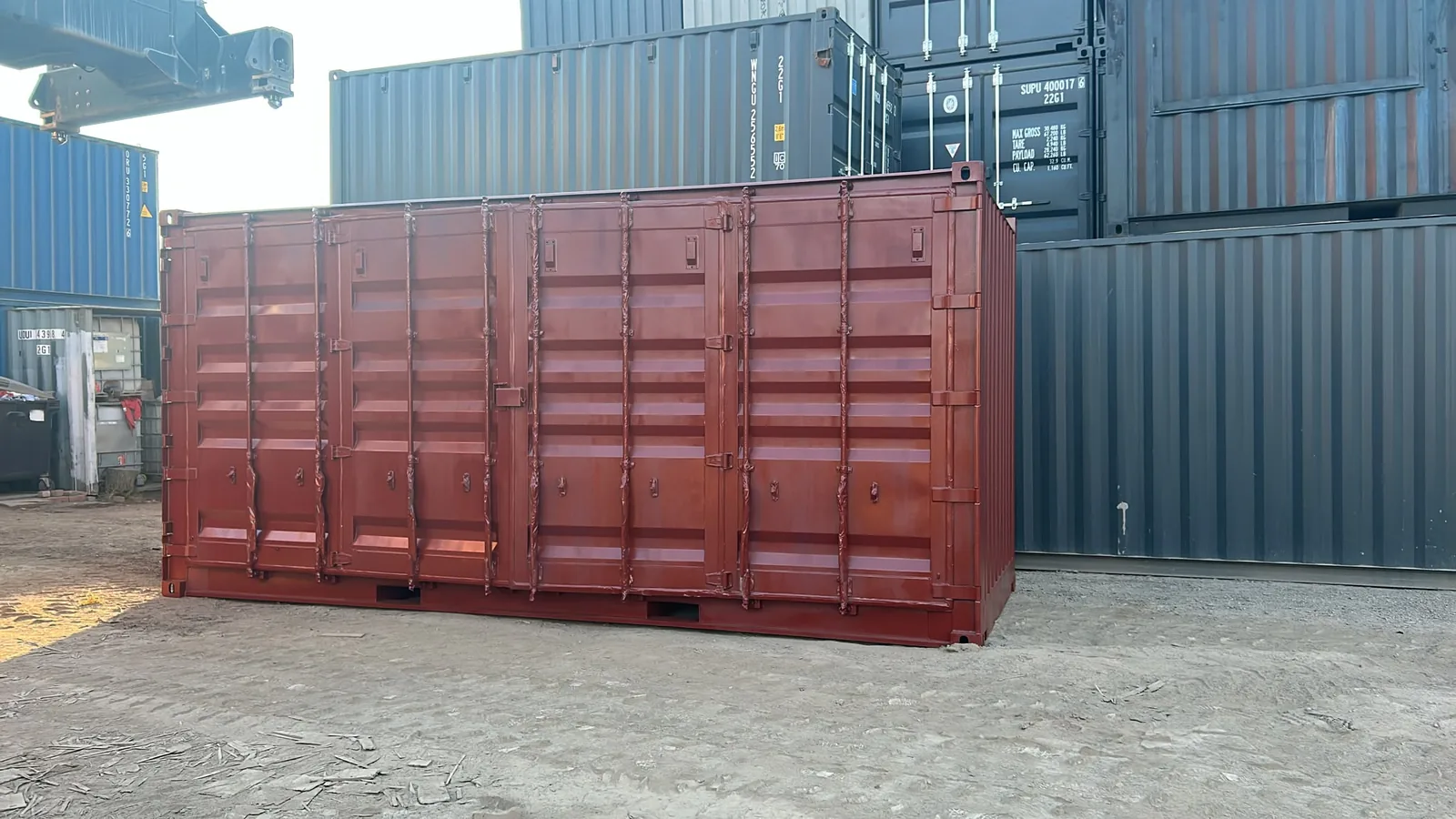
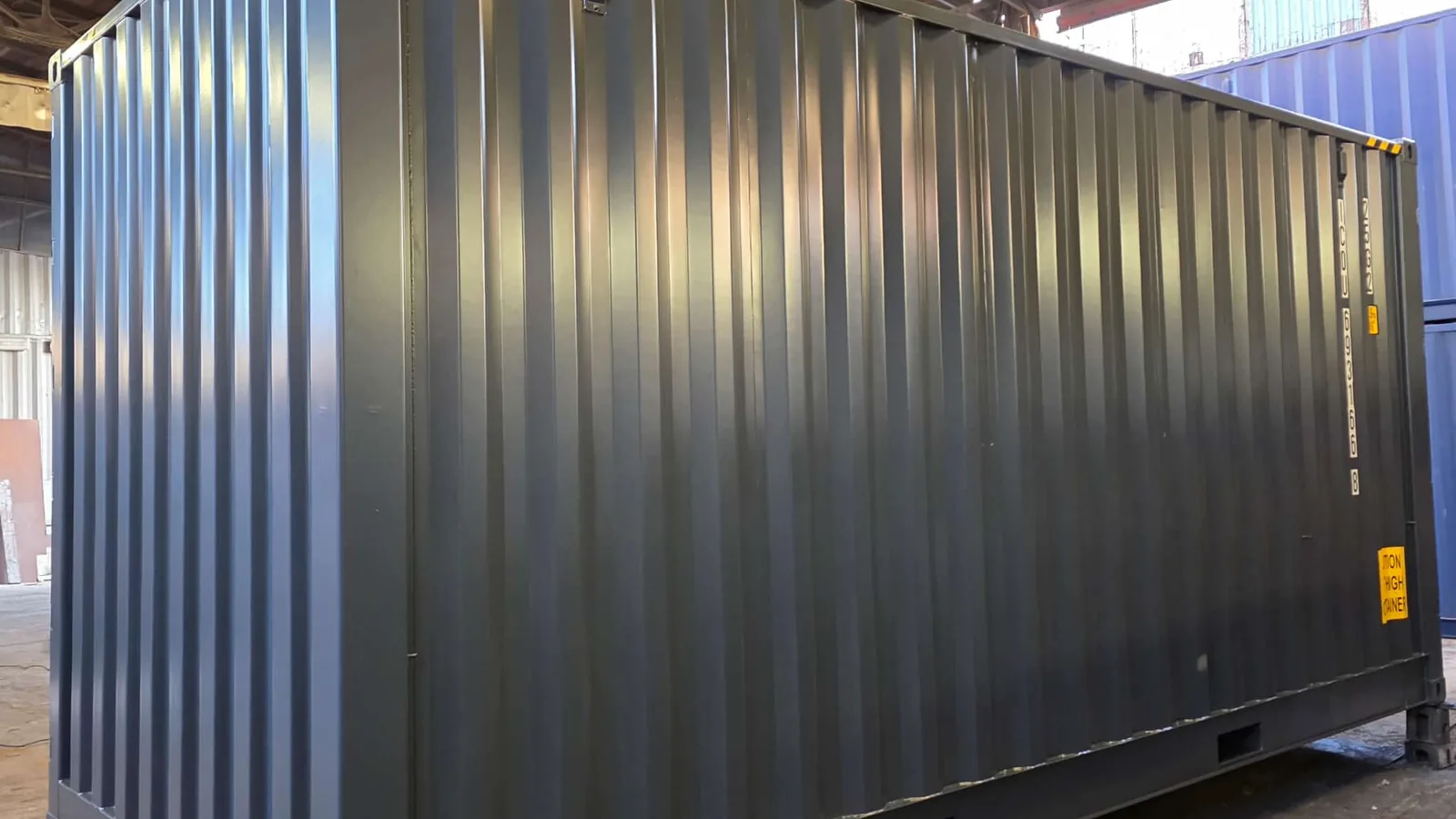
Containers are painted to match corporate colours, to protect them from rust or to improve their appearance where they will be on view. This page explains the preparation, the right paint system and how long the coating lasts outdoors – with a real before/
Preparation – the decisive step
80 % of the result comes from the preparation. The process:
- Cleaning and degreasing – salt, oil and dirt must be removed completely, otherwise the paint will not hold.
- Removing flash rust and loose old paint – sanding, brushing or blasting down to a sound substrate.
- Scuff sanding – even intact old paint is roughened so the new paint adheres.
- Repairing dents and rust spots – rusted-through areas are cut out and re-welded.
- Masking – seals, fittings, type plates and the CSC plate.
Do not skip the primer
On bare sanded or blasted steel, a primer must follow promptly – bare steel develops flash rust within a few hours, especially in damp weather. The primer creates adhesion to the substrate and provides the actual corrosion protection; the topcoat provides colour and UV resistance. If you apply the topcoat directly over the old paint, you save one step and pay for it later with flaking in exactly those places where the substrate was not sound.
The right paint system
| System | Build-up | Outdoor durability | Use |
|---|---|---|---|
| 2K epoxy primer + 2K PU topcoat | Primer + topcoat, each 2-component | many years | Specialist company, paint booth – for a durable, presentable coating |
| 1K protective metal paint | one coat, air-drying | a few years | Touch-ups, simple repainting, DIY |
For a container that will stand in a visible location for years, the 2K system is worthwhile. For a quick refresh or touch-up, 1K is often enough.
Application: spraying or roller?
Airless spraying gives the most even result on large surfaces and reaches into the corrugations. Roller and brush are the right choice for touch-ups, small areas and edges. In practice, the two are often combined: spray the surface, then finish the details by hand.
RAL colour and coverage
Any RAL colour is possible. Dark and strong shades (e.g. RAL 3000 Flame Red, RAL 5010 Gentian Blue) need more coats for full coverage than light greys. For an exact company colour, give us the RAL value or a sample.
Interior painting and floor coating
Different requirements apply inside: here the focus is less on UV resistance than on brightness, ease of cleaning and – in food or technical areas – an abrasion-resistant, low-dust surface. A light-coloured 2K coating on the walls and ceiling is common and noticeably brightens the interior. The Floor made of film-faced plywood or bamboo plywood is treated with insecticides at the factory; if the container becomes a living or working space, the floor is either sealed or replaced entirely. An epoxy floor coating makes the surface suitable for vehicle traffic and easy to clean, but requires a dry, sanded substrate.
How much does painting a container cost?
The price depends on the size (20 or 40 ft), the condition (how much preparation is needed), the colour (number of coats) and whether the inside and outside are painted. We will give you the price in our quote.
Have it painted by a specialist company
Coin Container prepares the container mechanically (sanding, blasting), repairs rust spots and paints with a 2K system – including conversion in the same job if desired. A real-world example is the repainting of a 20 ft HC Open Side in RAL 7016. More on this: Container conversion and modification and the case study Repainting in RAL 7016.
Next
Converting shipping containers · Insulating containers · Request a quote
Frequently asked questions
How do I prepare a container for painting?
Clean and degrease, remove surface rust and loose old paint, sand intact old paint, repair dents and rust spots, and mask off seals, fittings, nameplates and the CSC plate. Around 80 % of the result is determined by the preparation.
Do I need a primer?
Yes. Bare steel develops surface rust within a few hours. The primer provides adhesion and corrosion protection, while the topcoat provides colour and UV resistance.
1K or 2K paint?
For a container that will stand in a visible location for years, the 2K system is worthwhile. For a quick refresh or touch-up, 1K is often enough.
You can see examples of repainted containers (RAL 3009 Oxide Red, RAL 9006 Grey Aluminium, RAL 9005 Jet Black) at Container projects & case studies.
Last updated: 21 September 2026 · Editor: Coin Container Team, Hamburg