Guides & basics
Anyone dealing with containers for the first time quickly comes across terms such as ISO container, CSC, 20 ft, 40 ft, High Cube or container marking. Without context, this quickly seems technical. In fact, the basic principle is straightforward.
A ISO container is a container based on international standards. That is precisely why it can be used reliably in international freight – on ships, by truck, by rail and at terminals. It follows a clear system for sizes, marking and safety requirements. The most important foundations for this are ISO 668 for the basic sizes and classifications, ISO 6346 for marking, and the CSC Convention for safety in international use.
For businesses, this is not a theoretical detail. A standardised container is easier to plan, simpler to document and integrates more smoothly into logistics processes.
What does ISO mean in the context of containers?
ISO stands for International Organization for Standardization. In the container sector, this means there are internationally recognised rules for how containers are classified, how they are marked and on which basic principles they are used in international transport. The ISO overview page for freight containers lists, among others, ISO 668, ISO 1496-1 and ISO 6346 as key standards.
An ISO container is therefore not just any steel box, but a container that fits into a standardised transport and logistics structure.
Which standards are really important here?
For a solid basic understanding, three reference points are enough:
- ISO 668 – describes the fundamental container sizes and the basic classification.
- ISO 6346 – governs Coding, Identification and Marking, i.e. marking and identification.
- CSC – covers the safety requirements for containers in international use.
This already covers the basics of the topic: size, markings and safety.
What are the dimensions of ISO containers?
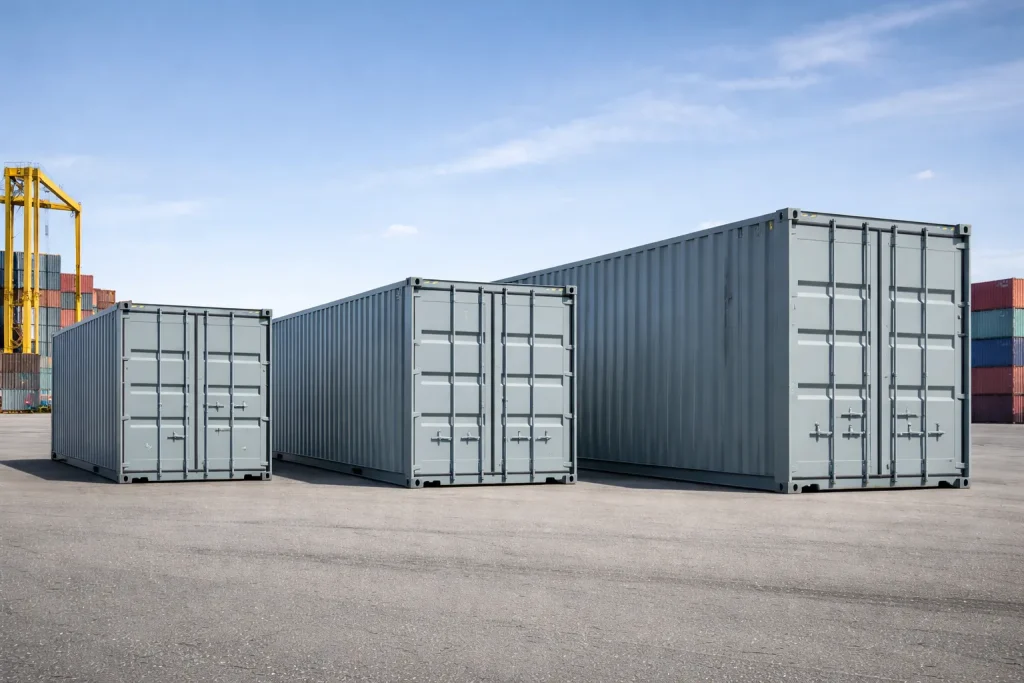
There are several standardised basic formats in the container sector. The most common are 20 ft container, 40 ft container and 40 ft High Cube container.
20 ft container
The 20 ft container is one of the best-known formats. It is often used when a compact, robust solution for storage or transport is needed.
Typical external dimensions:
- Length: approx. 6,06 m
- Width: approx. 2,44 m
- Height: approx. 2,59 m
Typical areas of use:
- Storage of materials
- Tools and equipment
- Smaller quantities of goods
- Construction sites
- Temporary storage for businesses
The advantage of this format is the combination of good usability and a manageable space requirement.
40 ft container
The 40 ft container is the classic choice when more volume is needed. It is used wherever larger quantities are to be stored or transported.
Typical external dimensions:
- Length: approx. 12,19 m
- Width: approx. 2,44 m
- Height: approx. 2,59 m
Typical areas of use:
- International transport
- Larger quantities of goods
- Storage solutions requiring more space
- Projects with greater volume requirements
The main advantage is the significantly larger interior while the format remains standardised.
40 ft High Cube container
The 40 ft High Cube container matches the classic 40 ft container in length and width, but is taller. This extra height makes it interesting for certain applications.
Typical external dimensions:
- Length: approx. 12,19 m
- Width: approx. 2,44 m
- Height: approx. 2,90 m
Typical areas of use:
- bulky goods
- Palletised goods
- Storage solutions requiring additional height
- Applications where the interior of a standard 40 ft container is not sufficient
The advantage is the additional usable volume.
Important note on dimensions
It is worth taking a closer look here. When standardised container dimensions are mentioned, this does not mean that every detail is identical to the millimetre on every container.
The following are mainly standardised:
- the basic types
- the basic external dimensions
- the general classification
In practice, however, interior dimensions, door opening, door height, construction details and individual usable interior clearances may differ slightly, depending on manufacturer, model, year of manufacture and container type. ISO lists ISO 668 as the standard for Classification, dimensions and ratings; the ISO sector page additionally lists ISO 1496-1 as the standard for Specification and testing. In practice, this means: if your planning depends on exact loading heights, pallet dimensions or technical equipment, you should always check the specific dimensions of the container offered.
What does the marking on a container mean?
Every ISO container carries a unique marking. It ensures that a container can be uniquely identified in documents, during transport and in logistics systems.
A typical example looks like this: ABCU 123456 7
This code consists of:
- the container owner code – the first three letters
- the category identifier – usually a U for freight container
- the serial number – six digits
- the check digit – the last digit, used to verify the code
In practice, this means that a container can be uniquely identified by this code. This exact logic is governed by ISO 6346 – Freight containers — Coding, identification and marking.
What is CSC?
CSC stands for Convention for Safe Containers. It sets out international safety requirements for containers used in international transport.
The IMO describes two basic objectives of the convention:
First, it aims to ensure a high standard of safety in the transport and handling of containers. Second, it aims to establish uniform international safety rules, so that countries do not each apply their own, differing regulations.
In practice, this means: a container used internationally must be built so that it meets the relevant requirements for safety and operational fitness.
What does this mean in practice?
In international transport, containers are regularly:
- lifted,
- moved,
- stacked,
- loaded,
- unloaded
- and transported over long distances.
If a container's structure cannot withstand these demands, or its technical condition is not adequately assured, this creates risks for people, equipment, cargo and the entire operation.
This is where CSC comes in:
- The container is given safety approval.
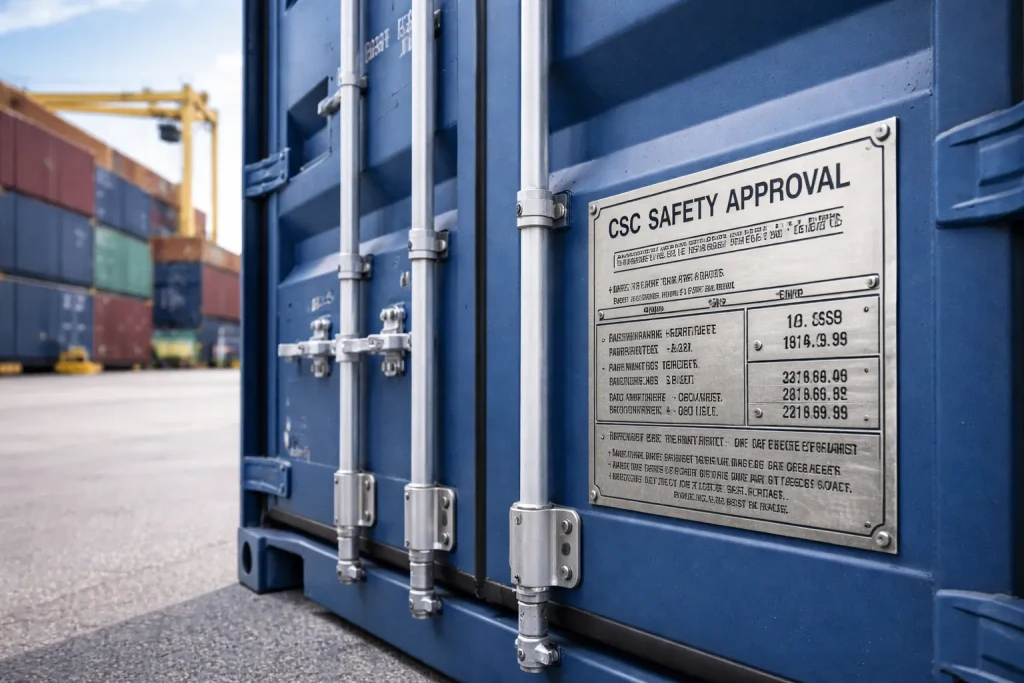
- It then receives a Safety Approval Plate, i.e. the CSC plate.
- This approval is intended to be recognised by other contracting states.
- Ongoing maintenance and periodic inspection are the responsibility of the owner.
For companies, this means one thing above all: a container with a valid safety status can be used in international transport far more safely and smoothly.
What is the CSC plate?
The CSC plate is a metal plate on the container. It documents that the container has been approved under the international safety rules.
The IMO explicitly states that approval is evidenced by a Safety Approval Plate and that this approval is to be recognised by other contracting states. The IMO also points out that the subsequent maintenance of a safety-approved container is the owner's responsibility.
For the reader, one thing is especially important: The CSC plate shows that the container has undergone a formal safety procedure and is classified as safe for international use.
How does an ISO container differ from a simple storage container?
Not every container that looks like a shipping container is automatically an ISO container as understood in international logistics.
A ISO container is part of a standardised system:
- standardised basic formats
- defined markings
- integration into international transport logistics
- safety framework for international use
A simple storage containers may be suitable for local applications, but does not necessarily meet the same requirements. For stationary use, this may be sufficient. For international transport, much clearer rules apply.
If, after this basic overview, you are looking for a specific solution right away, see our page on Buying a shipping container in Hamburg for further information.
Conclusion
A An ISO container is a standardised container for use in international logistics. Its advantage lies in its clear system: defined types, transparent marking and binding safety rules.
To put the topic into context, three key reference points are enough:
- ISO 668 – for types and basic dimensions
- ISO 6346 – for marking and identification
- CSC – for safety in international use
Once this foundation is clear, the topic seems much less technical – and the most important terms are easy to understand and place in context.
If you would like to clarify which container type is suitable for your application, you can contact Coin Container directly here.
FAQ
What is an ISO container?
An ISO container is a standardised container for international use in logistics. It is based on international standards so that it can be used uniformly in transport by ship, truck and rail.
What are the dimensions of an ISO container?
The best-known formats are 20 ft, 40 ft and 40 ft High Cube containers. The basic dimensions are standardised, but in practice interior dimensions, door openings and individual design details may differ slightly depending on the manufacturer and model.
Are all containers automatically ISO containers?
No. Not every container that looks like a shipping container automatically meets the requirements of an ISO container. What matters are standardised dimensions, correct marking and, depending on the use, safety-related requirements.
What does the marking on a container mean?
The marking serves to uniquely identify the container. It consists of the container owner's code, the category identifier, a serial number and a check digit. The basis for this is ISO 6346.
What does CSC mean for a container?
CSC stands for "Convention for Safe Containers". It concerns international safety requirements for containers used in international transport.
What is a CSC plate needed for?
The CSC plate shows that a container has been approved under international safety rules. It is important proof that the container has been assessed for safety for the relevant international use.
More container ideas and real-world examples:
Looking for a container?
Coin Container delivers new and used shipping, storage and office containers across Europe from regional depots – with verified condition and a dedicated contact person. Overview: Buy shipping containers.
Request a quote