Guides & basics
In spring, there is a significant rise in the number of cases in which container owners find moisture inside : dampness, water droplets, damaged packaging or even mould. Under Germany's climatic conditions, this problem is particularly relevant during the transitional seasons. In coastal cities such as Hamburg, Kiel, Bremen or Lübeck, the risk is further increased due to higher humidity and more frequent temperature fluctuations .
All of this is the result of a physical process that is predictable and controllable.
In this article you will learn:
- why condensation in shipping and storage containers occurs;
- why the risk is particularly high in spring, especially in Germany's coastal regions;
- how condensation in a container in practice can be avoided;
- in which cases a different container type makes sense.
What is condensation – and why do people talk about "container rain"?
Condensation is a physical phenomenon in which water vapour molecules contained in the air turn into water droplets when they come into contact with a cold surface.
In shipping or storage containers, this mainly affects the inner metal surfaces – especially the roof and the upper areas of the side walls. These cool down particularly quickly after sunset or during a sudden drop in temperature.
When warm, humid air in the container meets the cooled metal, moisture is deposited in the form of droplets. When enough droplets collect, they start to fall – hence the term "container rain" (container rain).
Why is the risk highest in spring (especially in Hamburg)?
In spring, three factors come together across Germany – but especially in Hamburg:
- increased humidity,
- frequent precipitation,
- strong temperature differences between day and night.
This combination creates ideal conditions for the formation of condensation in a container.
A typical scenario:
- during the day the temperature rises to between +15 and +20 °C → the air absorbs a lot of moisture;
- at night the temperature drops rapidly to between +4 and +8 °C → the container roof cools down quickly;
- the average relative humidity in Hamburg is often above 70 % in spring;
- after the winter, the ground and ambient air are heavily saturated with moisture;
- rain and fog occur regularly;
- the moisture condenses on the inner surfaces of the container.
Specific consequences of condensation
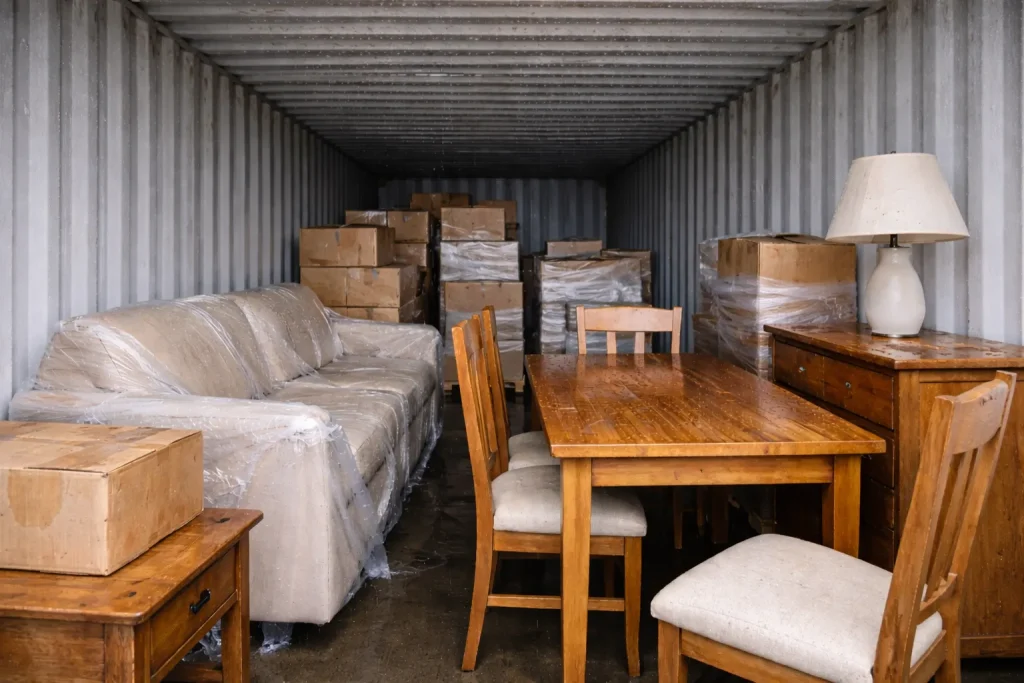
condensation in a container can lead to:
- cardboard packaging becoming soaked and losing its stability;
- warping or swelling of wooden elements;
- accelerated Corrosion of tools and metal parts;
- mould growth on textiles or furniture;
- persistent musty odour;
- loss of quality of the stored goods.
Even a few cycles of "heating – cooling" can cause considerable damage.
Main causes of condensation
1. Damp cargo or packaging
If wet pallets, building materials after rain or goods with high inherent moisture are loaded, this moisture stays in the container. It gradually passes into the air inside and increases the overall humidity.
2. Missing or insufficient ventilation
Standard shipping containers have only minimal ventilation openings. These ensure a basic exchange of air but are not designed for active dehumidification. Without sufficient air circulation moisture builds up.
3. Large temperature fluctuations
Metal walls react very quickly to temperature changes. As a result, the dew point is reached – the moment at which water vapour condenses into liquid.
4. Closing the container immediately after loading
If a container is sealed immediately after warm or moist goods have been loaded, the temperature difference between the inside and outside further increases the formation of condensation .
How can condensation be avoided? International standards
When searching for "how to avoid condensation in a container" technical guidelines should be the deciding factor – not forum opinions.
CTU Code (IMO / ILO / UNECE)
The international code of practice for packing cargo transport units expressly recommends:
- do not load moist cargo or packaging;
- maintain a gap between the cargo and the walls for air circulation;
- for longer storage periods, use desiccants ;
- check the moisture content of hygroscopic materials (wood, paper, textiles).
Basic principle: Minimise the amount of moisture in the container as early as the loading stage.
DIN 4108 (Germany)
The standard for thermal and moisture protection requires:
- Avoidance of condensate formation on interior surfaces;
- Use of thermal insulation to reduce temperature differences;
- Use of vapour barriers in heated rooms.
For containers, this means: If they are used as storage or work spaces, insulation considerably reduces the risk of moisture.
Recommendations from container manufacturers
- do not block ventilation openings;
- for stationary use, install additional ventilation grilles;
- use moisture absorbers;
- use insulated or refrigerated containers for sensitive goods.
At its core, it always comes down to two aspects: controlling moisture and controlling temperature.
Practical measures to prevent condensation
To prevent condensation in a container effectively:
- load only dry goods and packaging;
- do not allow direct contact between the cargo and the container walls;
- use pallets to allow air circulation under the goods;
- wait for temperature equalisation before closing completely;
- ventilate regularly in dry weather;
- dehumidifiers or moisture absorbers ;
- check interior surfaces regularly;
- in case of recurring problems consider insulation or a different container type.
Should you switch the container type?
If moisture problems occur repeatedly or particularly sensitive goods are stored, a standard container may be insufficient.
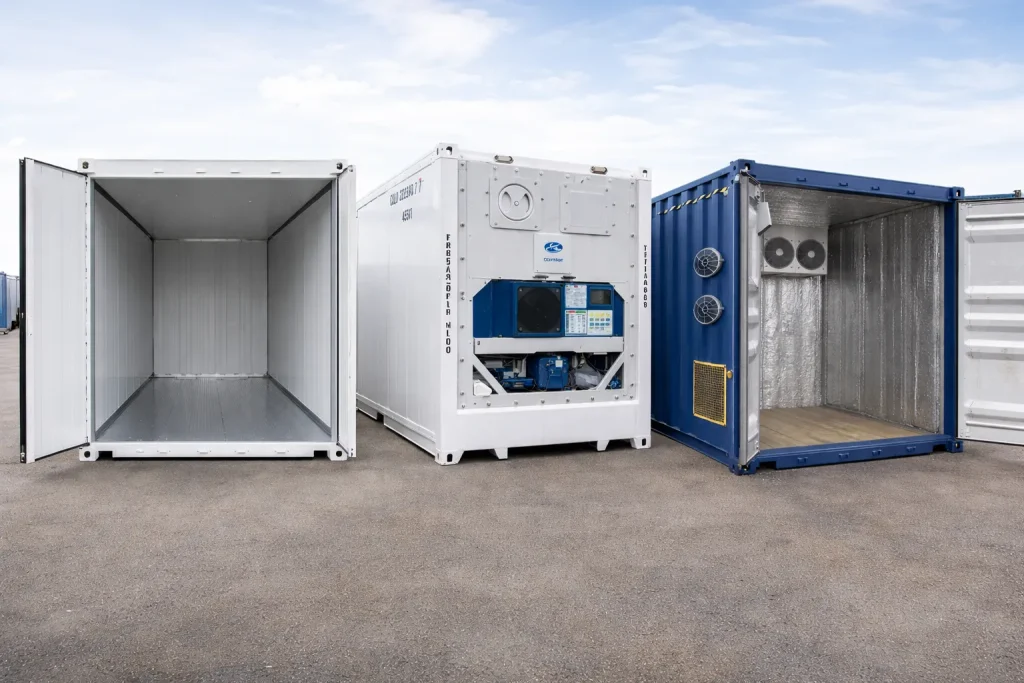
Insulated container
A insulated container has thermally insulating panels in the walls and roof. This prevents sharp reduces temperature fluctuations inside. Metal surfaces cool down less quickly at night – the dew point is reached less often.
Useful for:
- moisture-sensitive goods (furniture, paper, textiles, tools);
- year-round storage use;
- a need for a more stable microclimate without active cooling.
Main advantage: Reduced risk of condensation through temperature stabilisation.
Refrigerated containers
A Refrigerated containers has an integrated unit for active temperature control – independent of external weather conditions. Temperature and humidity are controlled instead of being influenced by day-night fluctuations.
Advantage:
- constant temperature prevents strong heating and cooling cycles;
- lower risk of falling below the dew point;
- minimal condensation even in difficult climatic conditions.
Useful for:
- temperature-controlled goods (food, pharmaceuticals, chemicals);
- products with no tolerance for humidity fluctuations;
- temporary storage solutions with controlled climate.
Container modification with ventilation or insulation
A technical modification of a standard container can reduce moisture problems without switching container type entirely.
1. Additional ventilation
- continuous air exchange;
- reduction of the relative humidity;
- prevention of "container rain".
2. Additional insulation
- smaller temperature difference between air and metal surfaces;
- reduced falling below the dew point;
- suitable for long-term outdoor use.
Main advantage: adaptation to specific operating conditions without investing in a refrigerated container.
Conclusion
Condensation in the container is a predictable physical phenomenon caused by moisture and temperature fluctuations – typical features of the German climate, especially in coastal regions such as Hamburg.
However, with proper loading, moisture control and, where necessary, technical adjustments, the problem can be reliably managed – and the goods protected over the long term.
You'll find more of our real team and project life on our social media:
Looking for a container?
Coin Container delivers new and used shipping, storage and office containers across Europe from regional depots – with verified condition and a dedicated contact person. Overview: Buy shipping containers.
Request a quote