Guides & basics
Shipping containers (also called sea containers or ISO containers) are now far more than transport boxes. They are used as mobile storage space, converted into technical units or deployed as flexible space solutions for projects. We work from Hamburg and organise delivery across Europe – so in practice we mainly encounter two questions: Which container variant is really the right one, and what needs to be in place on site for setup?
If you are looking for a suitable container, you can filter specifically by size, type and use in the container shop .
Why ISO containers are so versatile
The biggest advantage is standardisation: standard dimensions, a robust steel construction and handling that is compatible worldwide. This means containers can not only be transported efficiently but also stored, moved and fitted out for new purposes in a predictable way.
Which variants are relevant in practice?
Many decisions depend not only on “20 or 40 ft”, but on the specific use:
- Pallet Wide: useful if Euro pallets are to be loaded efficiently.
- High Cube: more interior height – practical for additional volume or certain installations.
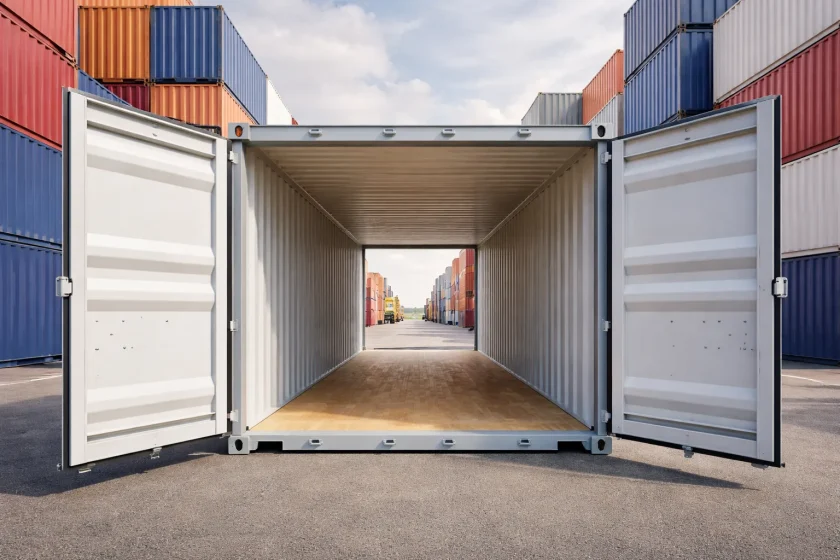
- Double Door: advantages when loading and unloading if access from both sides is needed.
- Open Side: ideal if a large side opening is essential.
- One-way: often of interest if you want a container in the “youngest” possible condition.
The quickest way to find the right combination is with filters – for example by size, height and door type in the container shop.
Storage: robust storage space for business and private use
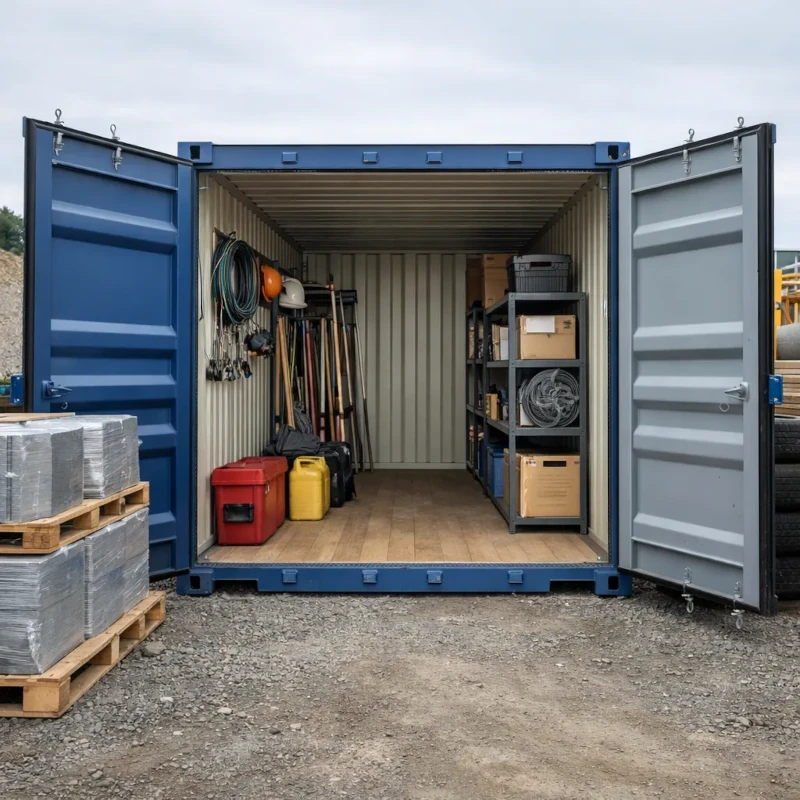
As storage containers, shipping containers are suitable for tools, construction site materials, spare parts, seasonal goods or archive items. Concrete criteria matter more here than buzzwords: watertightness, door function, the floor and a condition that suits the intended use.
For storage purposes, it is worth choosing the variant based on your loading and access scenario – not on gut feeling. If you work a lot with pallets, for example, Pallet Wide solutions are often more efficient.
Conversion & custom solutions: technical room, workshop, project container
Containers can be adapted very well to project-specific requirements – for example as a technical container, workshop, utility room or custom-planned special solution. Typical considerations include insulation, ventilation, electrical installation, doors/
You can find more about possible modifications at Container modification & conversion.
Delivery & placement: what really matters on site
In practice, a delivery rarely fails because of the container, but rather because of the site conditions. You should briefly check the following in advance:
- Access & manoeuvring space: Can the truck get in and out safely?
- Offloading: Crane, forklift or truck-mounted crane – which is planned?
- Ground: level, load-bearing, stable over time (so that the doors run smoothly).
- Positioning: Door side, opening angle, access for operation/
loading.
We have described the details of the process on our Container transport service page.
Renting or buying – which makes sense?
For short projects or temporary storage, renting can be economical. For long-term use or conversion projects, buying is often the more stable solution. The sensible approach is: first clarify the intended use, then choose the size/
FAQ
Which size fits better – 20 or 40 ft?
This depends primarily on the space available on site and the volume you need. 20 ft is more compact, 40 ft offers significantly more space.
High Cube or standard?
If interior height or storage space is decisive: High Cube. If footprint and budget dominate: standard may be enough.
Which variant makes sense for pallets?
If you plan to load Euro pallets efficiently, Pallet Wide is often the obvious option.