
Note: This page provides general guidance and does not constitute legal advice. The competent building authority (Bauamt) of your municipality is always the binding source. State building codes change; this overview is current as of September 2026.
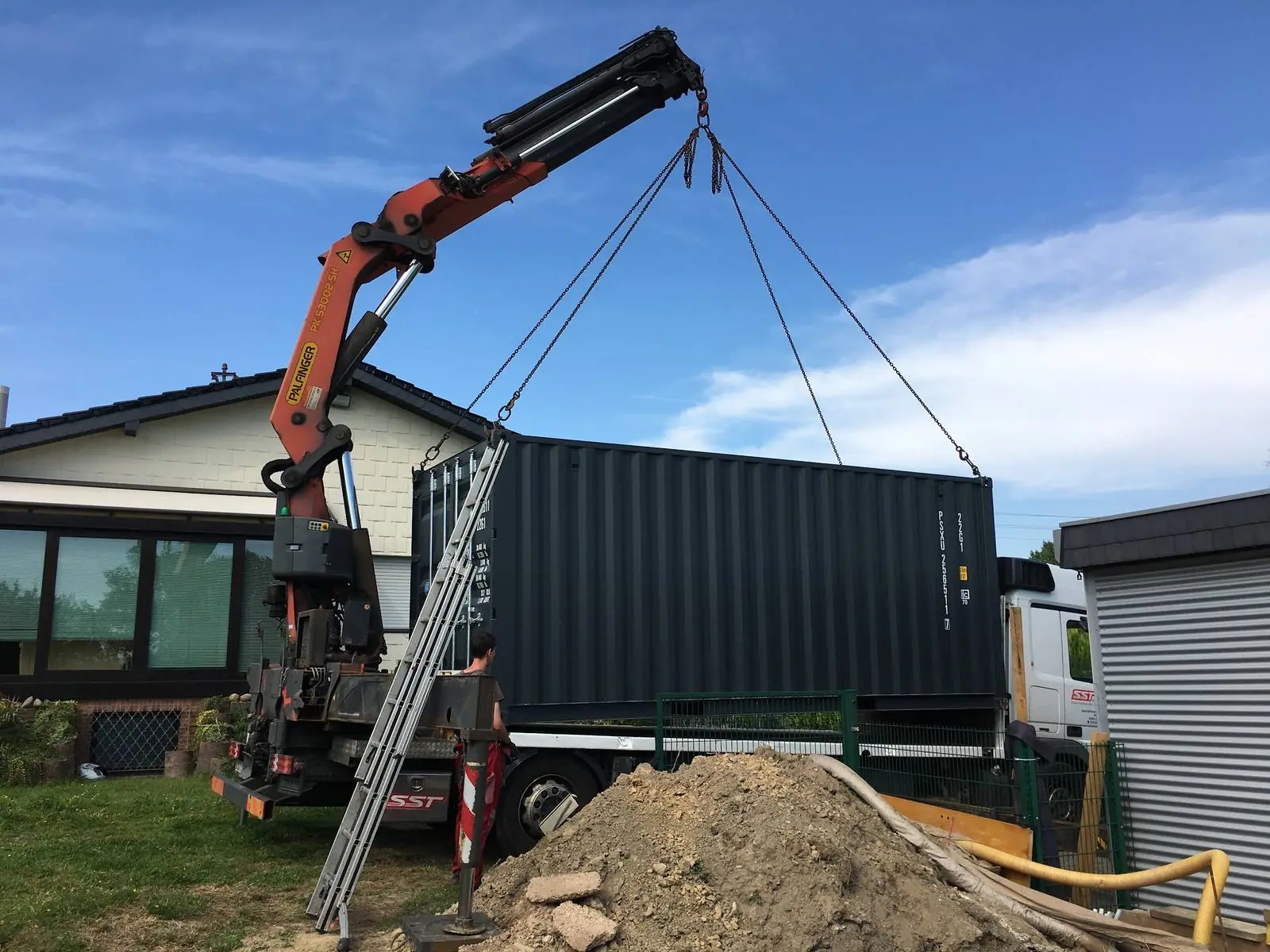
Whether a shipping container requires a permit depends on four things: its use, its size (volume), how long it will stand in place and the federal state. A 20 ft storage container placed temporarily in a garden is exempt from the permit procedure in many federal states. A container installed permanently and used as a habitable room requires a permit virtually everywhere.
Permit required or exempt? The 4 factors
- Use – pure storage is the least problematic. As soon as people spend time in it on a permanent basis (office, workshop with a workstation, living), stricter rules apply.
- Size / volume – the state building codes specify a threshold below which storage buildings are exempt from the permit procedure, usually as gross volume in m³. A 20 ft container has a gross volume of approx. 38 m³, a 40 ft container approx. 76 m³.
- Duration – containers placed only for the duration of construction are usually exempt from the permit procedure. However, “temporary” is not defined the same way nationwide.
- Location / federal state – each state building code (LBO) regulates this independently; in addition, development plans, heritage protection and setback distances may apply.
Container in the garden / on private property
As a storage containers it can be placed on private property without a permit procedure in many federal states, as long as the volume stays below the threshold of the relevant LBO and there is no permanent structural connection. Please note:
- Boundary distance – usually 2,5 to 3 m from the property boundary; directly on the boundary only under strict conditions.
- Development plan – may restrict or exclude ancillary structures.
- Use – a “garden house” container used for occupancy is not exempt from the permit procedure.
If in doubt, send an informal enquiry to the building authority – it costs nothing and gives you certainty.
Container on a construction site
Containers for site facilities (materials, office, sanitary) are generally exempt from the permit procedure for the duration of the construction work. They must be removed once the work is complete. Exceptions: very long construction periods, placement in public space (a special use permit is then required), protected areas.
Container for business / permanent use
For commercial or permanent use, a building permit application is usually required – in particular for a change of use (storage → sales room, office, habitable room), placement as an independent structure above the threshold, and connection to utility and sewage lines.
Building permit by federal state – overview
The maximum size of a storage container that may be placed without a permit (“exempt from the permit procedure”) differs from state to state and is set out in each federal state's building code, for example in the Hamburgische Bauordnung (HBauO), the Bayerische Bauordnung (BayBO) or the Landesbauordnung Baden-Württemberg (LBO BW). Your local building authority can tell you the current threshold for your federal state and your use.
The current version of the state building code and the information from the local building authority are always decisive.
Foundation, anchoring and structural stability
- Free-standing placement on concrete slabs or compacted gravel is the most likely to retain exemption from the permit procedure.
- Pad or strip foundation may be considered a “structural connection” and change the permit situation.
- In wind-exposed locations, anchoring is advisable – this is a matter of structural stability, not automatically of permits.
How to submit a building permit application
- Contact the building authority – a preliminary building enquiry clarifies in advance whether a permit can be granted.
- Compile the documents – site plan, construction drawing/
description, details on use and dimensions, structural stability certificate if applicable. - Submit the application – via the municipality or the building control office, usually through a planner authorised to submit building documents.
- Wait for the decision – processing time ranges from several weeks to months, depending on the authority.
Common mistakes
Permanently installing a container without checking first, ignoring the minimum distance to the property boundary, declaring it as “storage” and then using it as a workshop. More on mistakes related to buying and installation: costly mistakes when buying a container.
Frequently asked questions
Do I need a permit for a 20 ft storage container in the garden?
In many federal states it does not, as long as it is used for storage, stays below the permit-exempt threshold and keeps the required boundary distance. The building authority (Bauamt) has the final say.
How close to the property boundary can the container be placed?
Usually 2,5 to 3 m; directly on the boundary only under certain conditions. Varies by region.
Is a container considered a structure?
Yes – under building law, a container that has been set up is a structure, even though it is transportable.
What if I only set it up for one year?
“Temporary” is not defined the same way everywhere. If the duration is foreseeably limited, it helps to ask the building authority (Bauamt).
Do I need a permit for a residential container?
Yes. As soon as the container is used for permanent occupancy, it requires a permit. More on equipment and the process: Residential container.
Next
- Container conversion and modification
- Converting shipping containers – ideas and costs
- More basics: Container guide
Further reading
Request a quote · Buy a container · container transport · How much does a shipping container cost
Further reading: Residential container · Insulating a container · Conversion ideas · Permit-exempt (verfahrensfrei) in the glossary · Container guide
Last updated: 21 September 2026 · Editor: Coin Container Team, Hamburg