Guides & basics
A container is a quick solution if you need secure, robust and mobile space – for storage or work on company premises, construction sites, in logistics or for private purposes. And then the question immediately arises: buying or renting?
At Coin Container you get shipping containers, storage containers, special containers and refrigerated (reefer) containers – available for rent or purchase. You also have the option of having containers converted or modified to your requirements.
Buying or renting: two clear scenarios
To make sure the decision is not based solely on gut feeling , three simple guiding questions can help:
- How long is the container needed (weeks / months / years)?
- Are the requirements stable – or can the size/
type/ quantity still change? - What exactly will you use the container for (what will you store, how often do you need access)?
Below you will find two typical scenarios in which buying or renting makes particular sense. The deciding factors are usually the duration and how predictable your needs are.
When buying a container is worthwhile
Buying is generally practical and cost-effective if:
- Sie den Container langfristig – über Monate oder Jahre – nutzen möchten.
- Sie eine feste Lösung vor Ort suchen: einmal eingerichtet, zuverlässig im Alltag.
- Sie den Container als Investition sehen und ihn später an einem anderen Standort weiter nutzen möchten.
- Sie unabhängig von Mietlaufzeiten planen möchten, weil der Container dauerhaft verfügbar sein soll.
When renting is the better choice
Renting is usually the better option if:
- you need the container for the short to medium term (e.g. for a construction phase, a season or a project with a clear start and end).
- you are sure the container will no longer be needed after the project – and you simply want to return it afterwards.
-
your requirements may change (size/
type/ quantity), and you need the option to swap the container easily without being tied to ownership. -
you want to keep the initial investment low in order to reserve budget for the actual work/
investments.
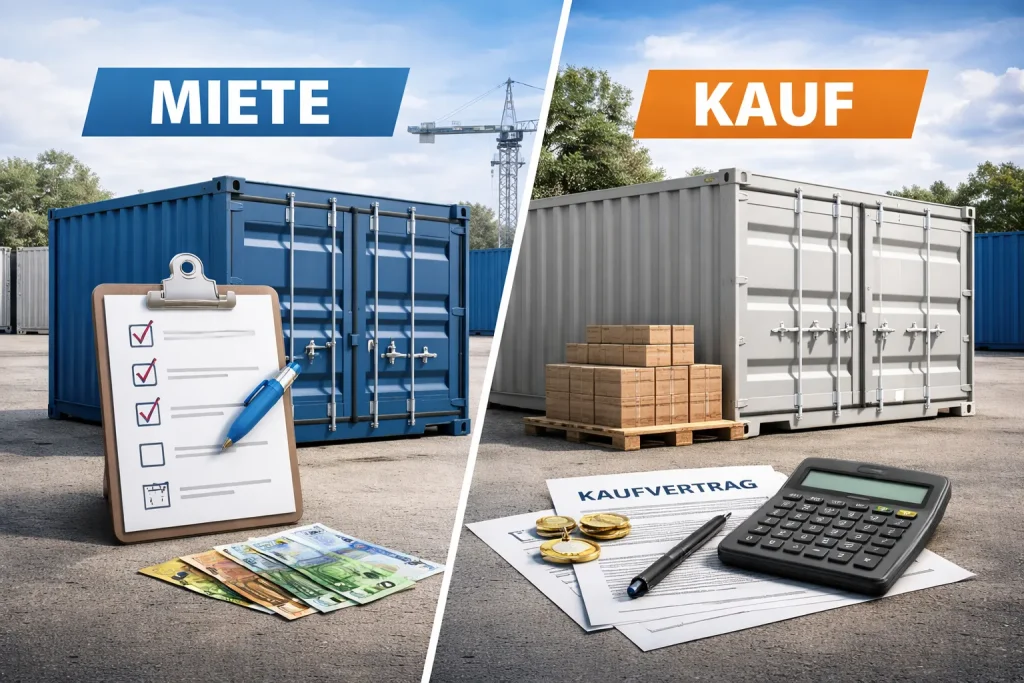
How to calculate which is cheaper: renting or buying
To make the comparison fair, you should not only look at "the container price" but at the total cost of use over the period for which you actually need the container. This lets you quickly see at what point buying or renting becomes financially advantageous.
Step 1: Define the terms
- N = number of months for which you need the container
- R = monthly rent
- M₀ = one-time costs when renting (e.g. delivery/
placement/ pickup – depending on the agreement) - K = purchase price
- B₀ = one-time costs when buying (e.g. delivery/
placement) - S = expected residual value/
sale proceeds at the end of the period (if you do not want to estimate: S = 0)
Step 2: Calculate the total costs
- Total cost of renting over N months:
C_miete = M₀ + R × N - Total cost of buying over the same period:
C_kauf = B₀ + K − S
Step 3: Determine the threshold / break-even point
- M₀ + R×N = B₀ + K − S
- It follows that:
N* = (B₀ + K − S − M₀) / R
Step 4: Interpret the result correctly
- If N > N*, then Buy is often more cost-effective.
- If N < N*, then Rent is often more cost-effective.
- If you are unsure about the residual value, calculate two scenarios: once with S = 0 (conservative) and once with a realistic S. This gives you a sensible decision range.
What determines the budget in practice
Even if the basic format (buying/
1. Container type, condition and size
Standard solutions are usually cheaper than special-purpose ones. In addition, new or nearly new containers often differ from used ones – for example in appearance, seals, doors, floor and general signs of use.
2. Logistics
Die Kosten hängen nicht nur von der Entfernung ab. Vielmehr spielen Zufahrt, Platz, um zu rangieren, und mögliche Einschränkungen (Breite/
3. Preparing the site
This refers to the area on which the container stands. Good preparation saves effort later: the container should stand securely, the doors should open without problems, and it must be possible to work safely around it. However, if the ground is uneven or lacks sufficient load-bearing capacity, levelling/
4. Security and everyday practicality
The right accessories often make the difference in operation: less risk, better control and more efficient processes. For example, additional theft protection can prevent losses, while ramps speed up loading and unloading. Likewise, connecting elements increase stability in container combinations.
5. Risk of changes to plans
If the size, type or number may change within 1–2 months, renting can avoid the costs that arise when you have to "correct" a decision. If, on the other hand, everything is fixed for the long term, that is often an argument for buying.
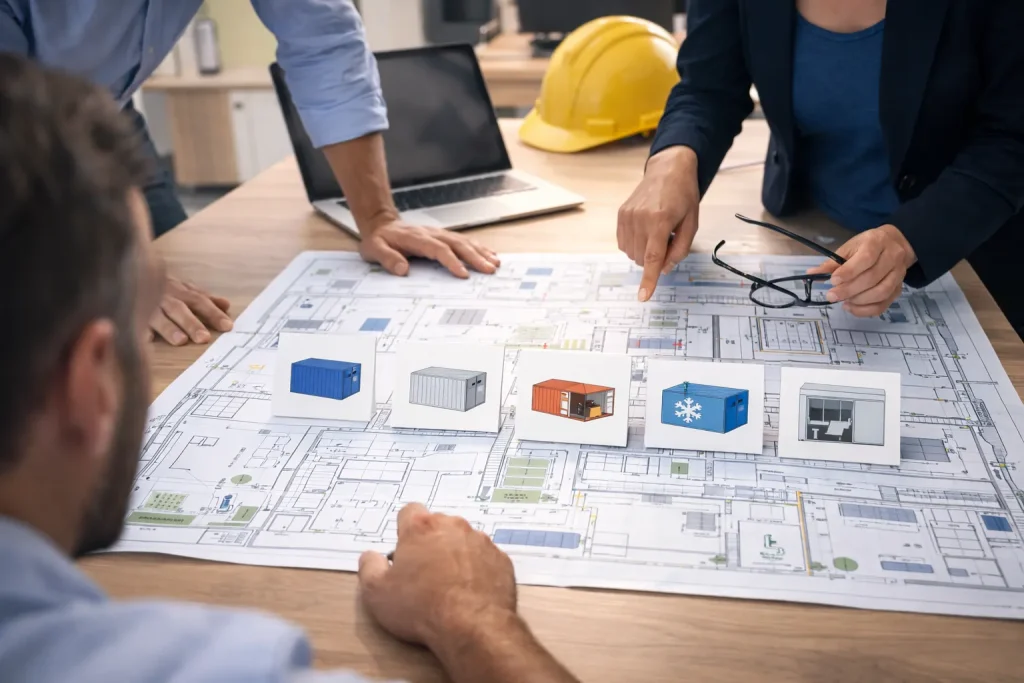
Which container type suits your use?
Ideally, choose the container type based on how you work with the goods and how often you need access. In short: access, volume, temperature and use are decisive. What matters is not only the size but also access (doors/
Standard containers are the classic, universal solution for storage and simple logistics: robust, lockable and ideal if you need a secure, weatherproof space. They are particularly popular for tools, building materials, spare parts, goods and seasonal storage space.
High Cube containers are like standard containers – only with additional interior height. This is worthwhile if you need more volume without taking up more floor space. Typical cases: bulky goods, higher stacking, bulky materials, or if you want to work better inside the container (more "air" in the space).
High Cube is often the right choice if "a standard 20 ft or 40 ft container" would generally work, but you notice: a few centimetres more height make a big difference in everyday use – when storing, manoeuvring and organising.
- Special containers
Special containers are the best solution if standard access is impractical or the cargo has special requirements. They save time, reduce detours and make certain processes efficient in the first place.
Typical variants:
- Open Side: Side opening along the length – ideal if you often remove goods pallet by pallet or need quick access to different areas.
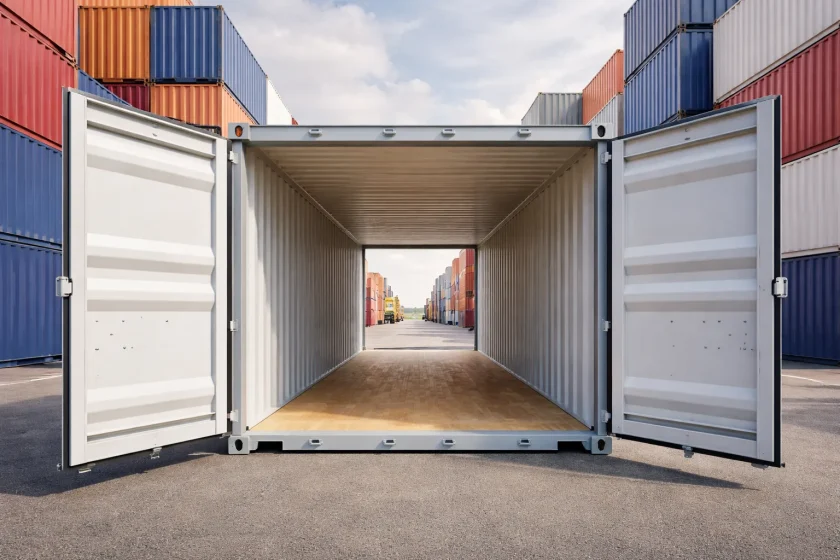
- Double Door: Doors at both ends – practical for "walk-through" access, better organisation and faster loading and unloading.
- Other special types are suitable, for example, for unusual dimensions, special loads or when working from above or with a crane.
- Refrigerated containers (reefers)
A refrigerated (reefer) container is the right choice when temperature is critical – e.g. for food, beverages, catering, events, pharma or sensitive materials. It is suitable both as a temporary cooling area (e.g. seasonal peaks) and as a solution you can plan for in projects where cooling is needed on site.
What matters most here is the right size (e.g. 10 ft/20 ft/40 ft) and the question of how you use the container: frequent opening, goods handling, short-term storage or a longer-term cooling reserve.
An office container is the practical solution if you need workstations directly on site at short notice – e.g. on a construction site, at a storage yard or on company premises. Typical uses are site management, project office, meeting room, registration/
To make sure you can really work on site, everyday practicality is what matters: lighting, sufficient power outlets, heating or air conditioning, insulation and windows/
Sanitary containers are ideal when you are on a construction site or at an event and quickly need reliable sanitary solutions – without depending on existing building infrastructure. Depending on the application, options include toilet containers, shower containers or combination modules (toilet + shower) .
They are particularly practical for construction sites, events, temporary locations, storage yards or anywhere that employees and guests need basic hygiene facilities. Two questions will help you choose: How many people will use the facility? and What equipment is needed (toilet only, shower only or combined)?
Container accessories – for your security and comfort
- Container lock:
Protects against unauthorised access and theft, especially in freely accessible areas. - Loading ramps:
Make loading and unloading with pallet trucks, hand trolleys or forklifts easier – less manual work, faster process. - Twistlock (container locking device):
For the secure connection/fastening of containers, e.g. when stacking. - Bridge fitting (horizontal connection):
Connects containers side by side and increases stability in modular structures.
Checklist: 5 questions that really help with "Buy or rent?"
- How long do you need the container: a few weeks, one season, a year or longer?
- Are you likely to need the container after the current project as well?
- Are your requirements fixed – or could the size/
type/ quantity still change? - Is a low entry cost more important to you – or maximum control in the long term?
- Should the container serve as a "mobile building block" that you reuse at different locations?
Would you like to know which solution suits your project? Write to us or give us a call – we will be happy to advise you and prepare a suitable quote ↓
You'll find more of our real team and project life on our social media: