Guides & basics
A One-way container is, in the trade, usually a like-new shipping containerthat was used only once in sea transport and is then sold. This is exactly why one-way containers are a popular alternative to buying new: almost like new, versatile in use and often more economical than a completely new container.
Note on terminology: In some contexts, "one-way" also refers to a leasing model with return at a different location. This guide is about one-way in the sense of buying, i.e. One-Trip/1-Trip.
What does "one-way" mean for shipping containers in practice?
In practice, a one-way container has been:
- newly manufactured,
- used once for sea transport,
- and then sold.
The result is usually very good visual and technical quality with minimal signs of use (e.g. minor scratches or handling marks on edges/
Advantages of one-way containers (one-trip / 1-trip)
As-new condition with minimal signs of use
One-way containers are often significantly "fresher" than conventional used shipping containers because they have no years-long service history.
Economical alternative to buying new
You get a solution that is visually and technically very close to "new" – often offering attractive value for money.
Versatile applications: storage, construction sites, industry, stationary use
Typical areas of use are storage containers, material containers on construction sites, commercial/
Standards, plates and documents: what you should look out for
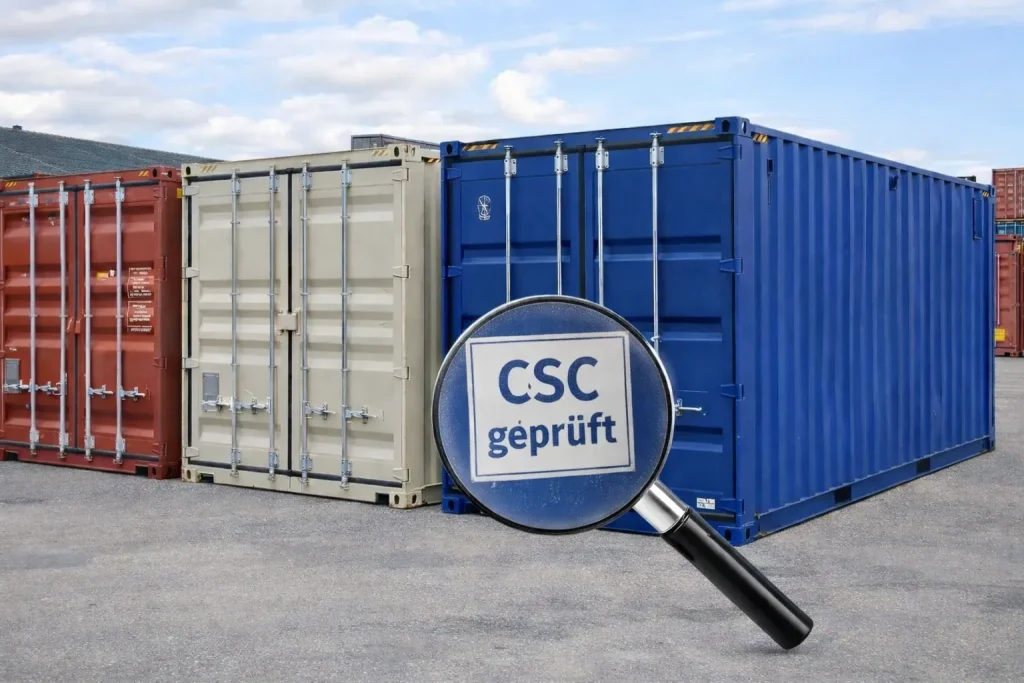
CSC plate
The CSC plate on the door is an important marking if a container is to be used in international transport. It can also be helpful for stationary use, as it allows basic data and markings to be assessed quickly.
Tip: If you are interested, ask for photos of the door end including the plates – this way, details can be clarified properly in advance.
Standardisation (briefly explained)
Shipping containers are internationally standardised. For buyers, this mainly means: compatible handling, a stable basic structure and comparable dimensions on the market.
Which sizes are in particular demand?
Depending on the project, space requirements, handling and use differ considerably. Frequently requested sizes include:
- 20 ft one-way container: compact, flexible, ideal as a storage or material container.
- 40 ft one-way container: more volume for storage, logistics or conversion projects.
- High Cube (HC): additional interior height, useful for bulky goods or fit-out.
What matters is what stored/
One-way vs. used: when does each make sense?
One-way is usually worthwhile if …
- appearance matters (company premises, customer contact, events, high-profile areas)
- you are planning for the long term and want less risk regarding condition/
wear - a conversion project is planned (e.g. workshop, technical room, storage solution)
Used is often a good choice if …
- price is the most important factor
- signs of wear do not matter (e.g. storage on a construction site only, with no public visibility)
Standards & plates: the CSC plate in brief
The CSC plate (on the door) is an important marking if a container is to be used in international transport. Even for stationary use, it often helps to quickly check the container's origin and basic data.
Tip: If you are interested, ask for photos of the door side including the plates – this lets you clarify details properly in advance.
Transport, placement and conversion: plan them from the start
Delivery & logistics
Depending on the depot location, access route and unloading (e.g. truck with or without crane), the logistics should be clarified early. If you need support with transport, simply state this directly in your enquiry.
Modification & conversion
Many customers buy one-way containers as a "clean base" for conversions (e.g. insulation, electrics, doors/
How much does a one-way container cost?
A one-way container is priced between a used and a factory-new shipping container – usually in the mid to upper four-digit range, depending on size, High Cube and availability. Transport from the depot is added. Because prices depend heavily on exchange rates and freight rates, we state the binding price in the quote. All cost factors and current guide prices: How much does a shipping container cost.
If signs of wear do not matter, a used shipping container is the more affordable choice. For a complete overview of types, conditions and the buying process, see the page Buy a container.
Checklist before buying
- Doors & locking: move smoothly, close cleanly
- Seals: no cracks, no visible leaks
- Floor: dry, stable, without deep damage
- Walls & roof: no major dents, especially on the roof
- Odour/
moisture: quick interior check for signs of mustiness - Clarify the intended use: storage, construction site, transport, conversion
- Clarify delivery details: access, ground conditions, unloading
- Plates/
markings: request photos of the door side including the plates (especially relevant for transport)
Would you like a Buy a one-way container? Just send us your key details – we will get back to you as soon as possible.
FAQ: Frequently asked questions about one-way containers
More container ideas and real-world examples:
Looking for a container?
Coin Container delivers new and used shipping, storage and office containers across Europe from regional depots – with verified condition and a dedicated contact person. Overview: Buying one-way and like-new containers.
Request a quote