Guides & basics
European container ports are not simply "places with cranes". They are hubs through which the import/
But importantly: A large port ≠ automatically the fastest and cheapest for your specific address. In a real order, three things are decisive:
- delivery city,
- the nearest logistically sensible "belt" of ports,
- Container type and condition (20’/40’/HC; new/
one-way/ used).
When you choose a container, the logic is simple: address → optimal loading point → container. In practice, this is the most common way to shorten the "land leg" (kilometres of road delivery) and keep the timeframe realistic.
Coin Container: We sell and rent out containers with delivery within Germany and the EU.
TEU – explained simply
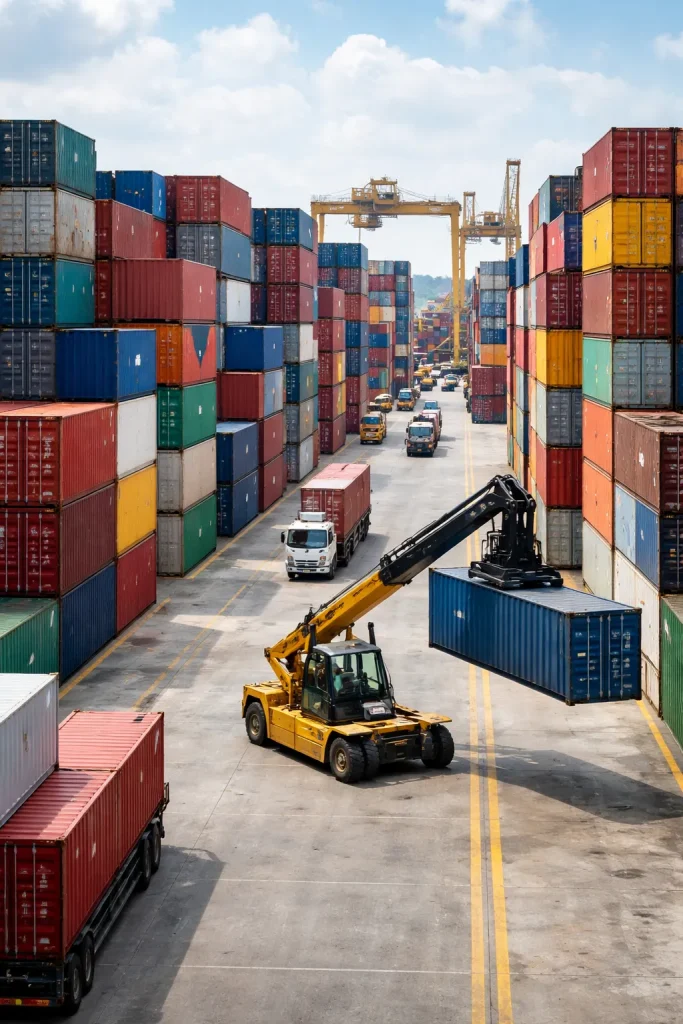
At first glance, measuring a port's container throughput seems fairly simple: count the containers in the ports and compare where more "fit through". But this is where a problem arises: containers come in different sizes (most commonly 20’ and 40’). If you count "numbers of containers", the comparison is distorted: a port may handle more 40 ft containers and appear "smaller" in unit numbers, even though it actually handles more cargo.
That is exactly why the TEU (Twenty-Foot Equivalent Unit) is used to measure container throughput – a "standard unit" equivalent to one 20 ft container.
How it is calculated:
- 1× 20’ container = 1 TEU
- 1× 40’ container = 2 TEU
(i.e. a 40 ft container statistically "counts" as two 20 ft containers)
So when a port reports "10 million TEU", it means that over the year a container volume equivalent to 10 million 20 ft containers passed through the port (i.e. the number of 20’ containers plus each 40’ container counted twice). TEU therefore shows the scale of throughput, but not how many containers are "sitting and waiting to be sold". TEU is a good indicator of where there are usually more logistics options and more containers in circulation, but actual availability (type/
How TEU affects container availability and delivery times
Higher likelihood of finding the right container:
- more containers come in/
go out, - a higher chance of finding the desired type (20’/40’/HC etc.) within a reasonable radius,
- a more active secondary market (used containers "turn up" more often where throughput is high).
More logistics options:
- more intermodal routes (rail/
road/ inland waterways), - more options for pickup/
delivery (making it easier to choose the optimal solution for transport from the terminal/ depot to suit direction and budget), - delivery can be organised faster (under normal terminal utilisation).
But TEU does not guarantee speed. Even the largest ports have peak loads, slots, pickup queues and terminal "time windows". Delivery time is therefore always a combination of port + route + transport availability + your location.
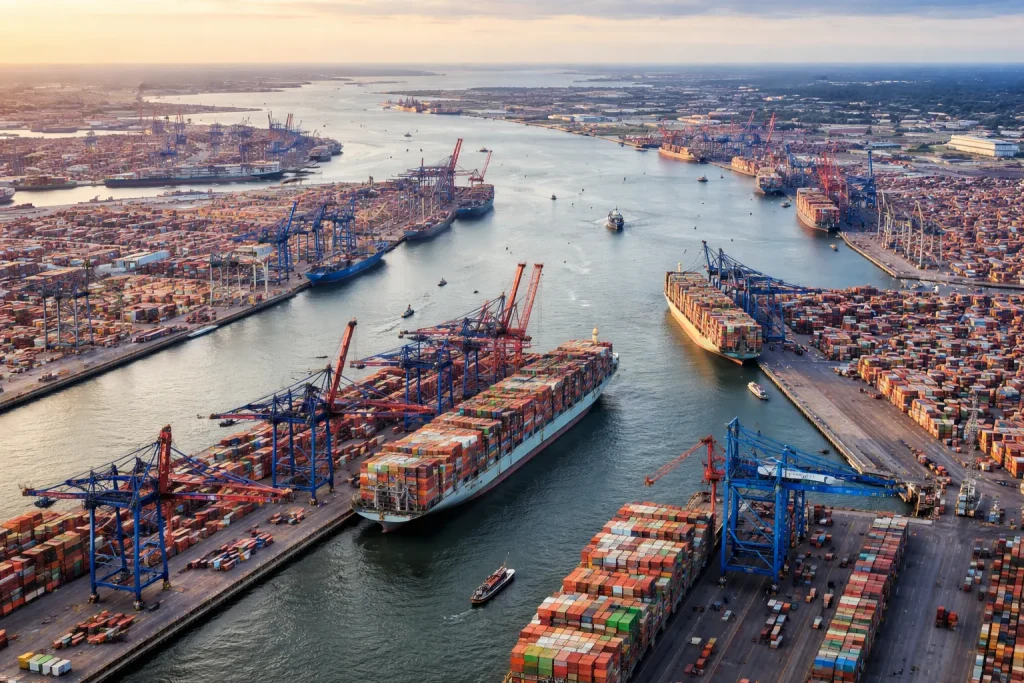
Europe's largest container ports (TEU): "belts" and selection logic
Europe is one of the densest port regions in the world: along the EU coast there are over 1.200 commercial seaports (all types, not just container ports).
In practice, container flows are concentrated in several "belts":
1. Northern belt (North Range: Hamburg–Le Havre region):
- The strongest cluster for import/
export and distribution to Germany, the Benelux countries, France and Central Europe. - Typical "anchors": Rotterdam, Antwerp–Bruges (Zeebrugge), Amsterdam, Hamburg, Bremen/
Bremerhaven, Wilhelmshaven, Le Havre, Dunkirk. - Pros: high call frequency, strong intermodality, wider container selection in the region.
- Downside: during peak periods, slots/
queues/ terminal restrictions can affect planning.
- The strongest cluster for import/
2. Mediterranean belt (Mediterranean region)
- A strong cluster for Southern Europe and routes across the Mediterranean (including transit/
transshipment). - Hubs: Valencia, Barcelona, Bahía de Algeciras, Marseille/
Fos, Genoa, Gioia Tauro, Piraeus. - Advantages: often a shorter "inland leg" for Spain/
southern France/ Italy/ Greece. - Note: some of the hubs are transit-driven – it is important to know where the container is physically available (terminal/
depot) and how pickup is organised.
- A strong cluster for Southern Europe and routes across the Mediterranean (including transit/
3. Baltic Sea / Northern Europe (Scandinavia & the Baltics)
- A logical choice for Poland, the Baltic states, Finland, Sweden and northern Germany/
Denmark. - Pros: it is sometimes simpler and cheaper to cover the "last mile" in the north.
- Cons: TEU volumes are usually lower, and the selection can be more limited.
- A logical choice for Poland, the Baltic states, Finland, Sweden and northern Germany/
4. Black Sea direction (Black Sea region)
- A cluster for Romania and Bulgaria (Constanța, Varna, Burgas).
- Pros: geographically logical for the region.
- Downside: compared with the North Range, the frequency and choice of global services are often more limited – timings depend more heavily on the specific line/
terminal.
Top ports by container throughput (TEU)
Below are the most influential ports by container throughput (2024*). This is not the complete "Top 15", but a focused overview of the ports that most often set the tone in Western European logistics.
| Rank | Port | Country | Container throughput, 2024 |
|---|---|---|---|
| 1 | Rotterdam | NL | 13,8 million TEU |
| 2 | Antwerp–Bruges | BE | 13,53 million TEU |
| 3 | Hamburg | DE | 7,8 million TEU |
| 4 | Valencia | ES | 5,48 million TEU |
| 5 | Bahía de Algeciras | ES | 4,71 million TEU |
| 6 | Barcelona | ES | 3,89 million TEU |
* 2024 was used for the comparison because it is the latest year for which comparable, complete annual results for the ports in the table are available in open official publications.
A quick practical comparison: which port usually suits whom
| Port | For whom/ | Strongest point | Typical factor affecting timing |
|---|---|---|---|
| Rotterdam | Benelux, DE, FR, Central Europe | maximum logistics options and "Plan B" possibilities | possible slots/ |
| Antwerp–Bruges | Benelux, DE, FR, industrial routes | very dense ecosystem, strong industrial hinterland | important to choose the pickup point/ |
| Hamburg | Germany + neighbours (PL, CZ, DK, etc.) | practical hinterland in DE and CEE | for Southern Europe, overland transport can take longer |
| Valencia | Spain / Iberian Peninsula | shorter "overland leg" within Spain | to Central Europe usually longer/ |
| Algeciras | Southern Spain, part of transit flows | strategic location near Gibraltar | Transit specifics: it is critical to know where the container is physically available |
| Barcelona | Catalonia, parts of the Mediterranean | regional advantage and intermodality | for Central/Northern Europe, "northern" hubs are often more cost-effective |
The conclusion is simple: you don't choose the port "by ranking" but by delivery address.
Germany/
Hamburg as a key hub for containers in Germany and Europe
For Coin Container, Hamburg is not "just a port in the ranking", but a practical base, from which a predictable delivery leg within Germany and the EU can often be organised.
For you:
- We select the container to suit the task from: 20’/40’/40’HC, new/
used, for storage, construction, projects, etc. - We choose the loading point to suit your address so that you do not pay for unnecessary kilometres: sometimes it is the Hamburg area, sometimes another point closer to the delivery location (this is normal and often saves money).
- We organise the delivery taking into account on-site access (access road, time window, need for a crane/
handling equipment). - If required, we supply Accessories and additional equipment, so that the container is ready for use.
Do you need a container with delivery?
Fill in our form below and we will select the container and the nearest loading point so that delivery makes sense in terms of cost and delivery time.
You'll find more of our real team and project life on our social media: