Guides & basics
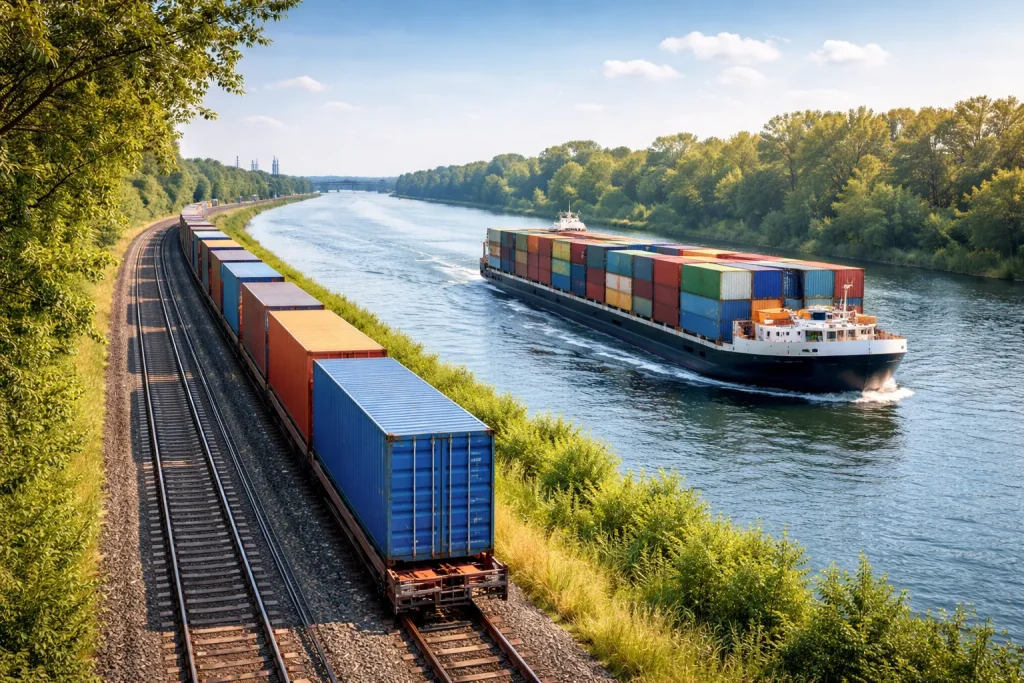
Intermodal container transport is a key lever for sustainable logistics: it makes switching between truck, rail and ship easier and can reduce emissions and transport costs.
Containers enable intermodal transport chains in which the goods stay in one loading unit. When the mode of transport changes, in practice the loading unit is transferred at the terminal – this creates predictable processes and supports the modal shift to rail and ship.
What does intermodal (combined) transport with containers mean?
Intermodal transport means: goods are transported in one loading unit (e.g. a container) using at least two modes of transport . When the mode of transport changes, in practice the loading unit is transferred at the terminal – the goods stay in the loading unit.
The Combined transport typically relies on the main leg being carried out by rail or ship and the truck handling only the pre-carriage and on-carriage .
Why containers make processes more efficient
Containers are standardised and established worldwide. In practice, this brings clear advantages:
Less handling of the goods: The loading unit is moved, not each individual package.
Faster transshipment processes: Terminals are optimised for standardised units.
Predictability & scalability: Standard sizes simplify dispatching, storage planning and capacity management.
Protection & security: Closed, sealable units reduce the risk of damage and loss.
Reducing CO₂ with intermodal container transport: rail & ship
The biggest climate lever in intermodal container transport is shifting freight from road to rail or (inland) waterways.
In Germany, the following (average) greenhouse gas emissions per tonne-kilometre are reported (CO₂e, g/tkm; reference year 2024):
All trucks (from 3,5 t gross vehicle weight): 118 g CO₂e/tkm
of which truck-trailer and semi-trailer combinations (typical for long-haul transport): 101 g CO₂e/tkm
Freight trains: 14 g CO₂e/tkm
Inland waterway vessels: 32 g CO₂e/tkm
Source: Umweltbundesamt (UBA), TREMOD 6.71B (10/2025), reference year 2024.
Example calculation (simple & easy to follow)
You transport 20 tonnes being carried out by 500 km.
- Tonne-kilometres: 20 t × 500 km = 10.000 tkm
- Emissions (typical long-distance transport: trucks and semi-trailer combinations = 101 g/tkm):
Truck: 101 g/tkm × 10.000 tkm = 1.010.000 g = 1.010 kg = 1,01 t CO₂e
Rail: 14 g/tkm × 10.000 tkm = 140.000 g = 140 kg = 0,14 t CO₂e
Difference (average): 1,01 − 0,14 = 0,87 t CO₂e less.
Note: These are average values. Actual emissions depend on factors such as load factor, route, electricity mix, and pre- and post-carriage.
Sustainability through service life and reuse
Containers are robustly built and are often used for many years in practice. This is especially sustainable when:
used containers are put to use (saving resources),
One-way container are used (almost like new, often more economical than new),
containers are repaired, refurbished or converted instead of new ones being produced.
Examples: 20 ft one-way, Used 40 ft
Buying or renting a container – which is more sustainable?
Renting a container (often makes sense for):
short-term needs (peak season, project business),
changing locations,
clear budget planning (predictable costs over the rental term).
Buying a container (often makes sense for)
long-term needs,
custom equipment/
modification (e.g. insulation, electrics, conversion), repeated use (permanent logistics or storage solution).
Practical tip: If sustainability and cost are the focus, "new vs used/
Which container types suit sustainable logistics strategies?
The right choice avoids empty space, additional trips and replanning:
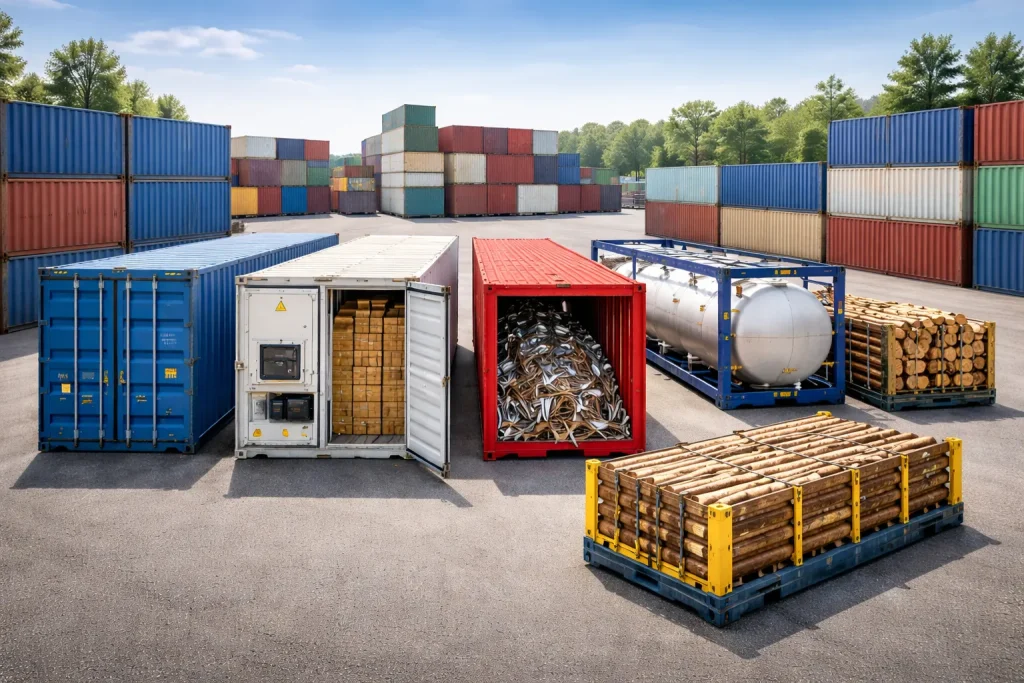
Standard containers: for storage and classic transport/logistics tasks
High Cube: more interior height – useful for bulky goods
Open Top: ideal for machinery/
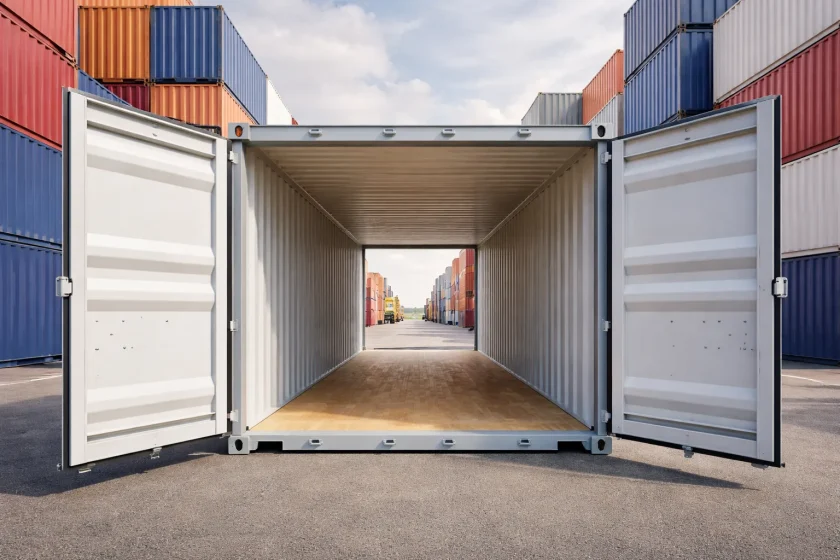
over-height project cargo Double Door / Open Side: quick access – reduces idle times during loading and unloading
Refrigerated containers (reefers): for temperature-controlled logistics (particularly relevant with a clean energy supply)
How companies get the most out of container logistics
Choose the right size (oversizing creates empty volume and unnecessary costs).
Reduce transport distance (delivery from the nearest possible stock/
depot). Consider intermodal transport for longer distances (main leg by rail/
ship, truck only for pre-/on-carriage). Optimise loading (utilisation is a key emissions driver per tkm).
Combine multiple deliveries (fewer trips, better use of capacity).
Choose the condition deliberately (used/
one-way saves resources and often budget). Conversion instead of buying new (modification extends service life).
Intermodal container transport: fewer handovers, more reliable planning
In practice, sustainable logistics often fails not because of the goal, but because of implementation: lack of availability, unclear responsibilities and too many handovers. When companies plan containers, transport and (if needed) modification together, they benefit from:
less coordination effort,
faster project handling,
better schedule reliability,
better cost control.
If you are planning intermodal container transport, we support you with container purchase, rental, transport and modification!
You'll find more of our real team and project life on our social media: