Guides & basics
In container and warehouse logistics, there is a simple rule: If access to goods is slow, you lose time every day. That is exactly why the Double Door container is often highlighted as a container solution of its own – a container with cargo doors at both ends. The basic idea is simple: two full-fledged access points, which allow more organisational flexibility – from faster access to goods to clearer processes around storage and retrieval.
If you are looking for a solution for your specific needs, you will find the right starting points directly on our website:
What is a Double Door container and why is it called a "tunnel container"?
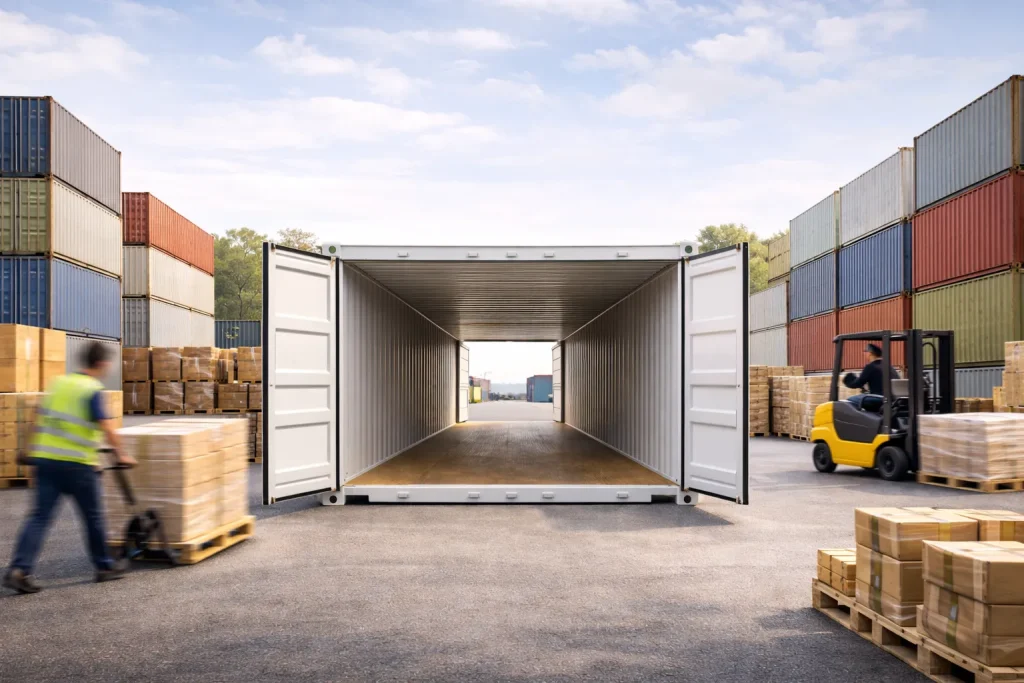
A Double Door container is a container with doors on both ends – not just on one side. That is why it is often referred to in the industry as a “tunnel container” : with the doors open, it can be used like a “passageway” from one side to the other.
3 key advantages of a Double Door container
1) Better organisation: separate processes and reduce “congestion” at the door
The benefit of two access points is not just “entering from the other side”. The real advantage is that you can separate workflows cleanly , for example:
at one end delivery / storage,
at the other end dispatch / removal.
This means fewer situations in which one access point is blocked and everything has to wait. Suppliers emphasise exactly this practical benefit (“two access points”) in their product descriptions.
2) Reach goods without “unloading everything”: fewer handling steps, lower risk of damage
This is a different, clearly separate advantage: if the goods you need are “at the far end”, a standard container often means having to partially or completely unload itjust to get to them. With a Double Door container, you can instead access it from the opposite side and take out what you need without completely rearranging the container. Typical industry descriptions explicitly cite this as an advantage.
3) “Container corridor” on projects: explained with an example
This advantage is particularly interesting in projects outside traditional storage environments – here are two very tangible examples:
Construction site next to a pavement: When work is carried out along a building, the walkway often has to be routed safely. A Double Door container can (depending on design/
safeguarding) serve as a protected passageway : people enter at one end and exit at the other – without crossing the work zone. Such applications are described as a “walkway tunnel” in industry articles. Practical example – “Container Walkway”: Royal Wolf describes a project in which container solutions were used to guide pedestrians safely past the construction activity, while operations and construction site logistics were able to continue.
Benefits first – then the suitable areas of use (without repetition)
The key benefits in one sentence
Separate workflows (storing vs. dispatching) and reduce waiting times at the access point.
Get to the right goods faster without rearranging the entire container.
passage/
route layout as part of temporary infrastructure.
Where each benefit has the strongest effect
storage/
retail with frequent access to individual items : Advantage (2) is decisive here – you save time because you can reach goods directly from the appropriate side.production/
service, where items are “restocked” and “removed” at the same time : Advantage (1) has the strongest effect – storing and dispatching interfere with each other less because you can organise workflows across two ends.Construction sites with little space in front of the container: a combination of (1) + (2) – less crowding at one access point and quick access to materials without rearranging.
Projects with safety and routing requirements: Advantage (3) – if a protected passageway is needed, the tunnel approach can be a suitable solution.
How professionals choose: what really matters
1) Choose the size and height to suit the use and the available space
If the container is to be used in the context of transport/
In practical terms:
- If a compact footprint and easy placement are important, a shorter length is often chosen.
- If more space and more comfortable working conditions inside are relevant, a longer version makes sense.
- If more interior height is needed (e.g. for shelving or taller cargo), High Cube is worth considering.
2) If the container is intended for transport: What does CSC mean, and what should you check?
CSC (International Convention for Safe Containers) sets out international safety requirements for containers used in transport. The IMO explains: Maintenance and regular inspections are the responsibility of the owner.
A plain-language summary for first-time buyers:
- If the container via logistics chains/
freight forwarders/ (especially internationally), make sure that a valid CSC plate is present.ports - BIC explains that containers for international transport must have a valid CSC plate and describes where it is typically fitted (often on the outside of the doors). (Source: bic-code.org)
If the container is used exclusively as a stationary storage unit , CSC is often less critical in everyday use, but it can be helpful as an indicator of quality and condition, depending on the application.
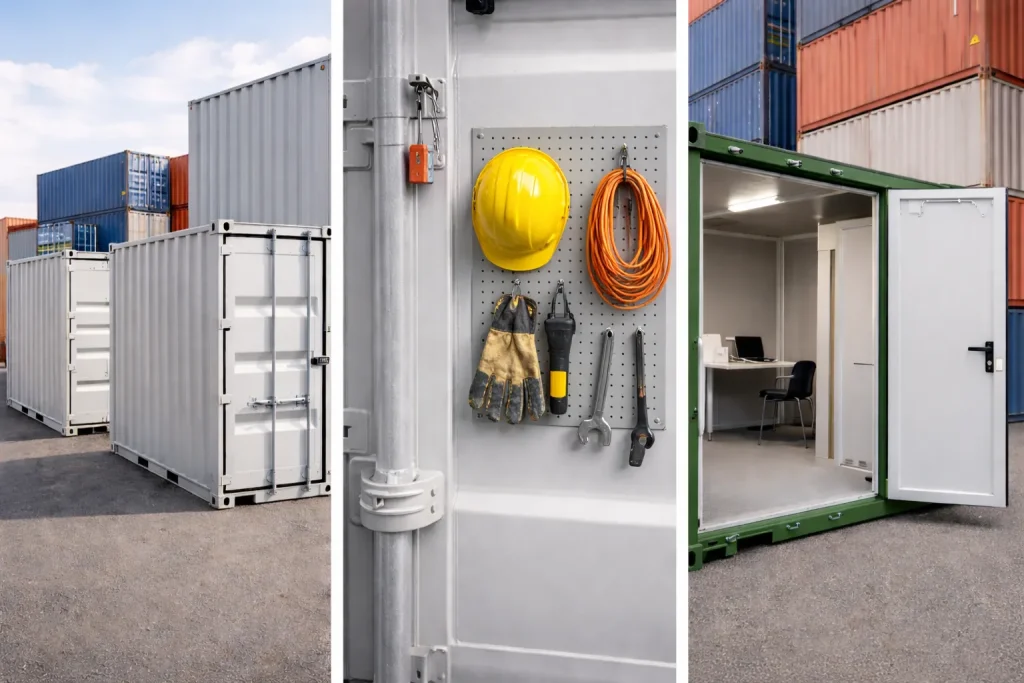
3) Modifications & equipment: add functions to suit the intended use
providers of converted/
8 practical tips to ensure Double Door really saves time and simplifies workflows
- Decide at which end the storage/
delivery takes place make sense, and at which end the removal/issue takes place should take place. - Plan your storage so that one side is not permanently blocked ; otherwise the advantage of the second door is lost.
- Organise the interior clearly, e.g. zone near door A / middle / zone near door B – and assign product groups to fixed locations.
- Plan the work area for daily operations: If pallet trucks or forklifts are used, you need enough space to manoeuvre and a suitable surface.
- Lighting increases speed and safety: good visibility reduces search times, errors and accident risks.
- Consider ventilation and moisture: For moisture-sensitive goods (cardboard, textiles, power tools, etc.), it helps to take precautions against condensation.
- Security should be planned in from the start – especially in openly accessible areas (e.g. with a container lock)
- Check delivery & placement separately. This point concerns the one-time delivery/
offloading : Is the access route suitable? Is there space for offloading? Is a crane required? Are there any narrow points (gates, passageways, cables)?
You'll find more of our real team and project life on our social media: